Twelve stitches, and the year the glue failed
Craft · 6 min read · 2026.11.18
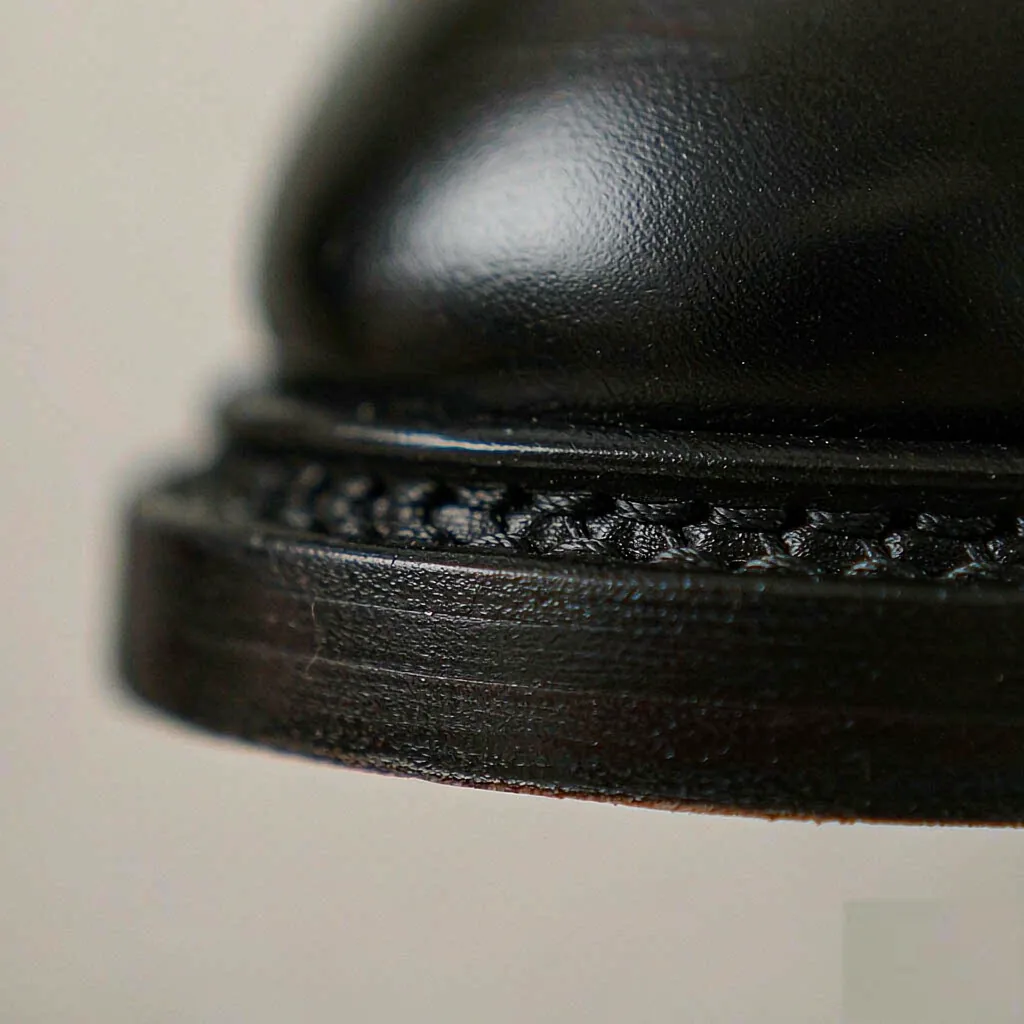
In 2019 we shipped a run of derbies with a 9-stitch welt. The feedback came back two years later, from Kuala Lumpur, in the form of a photograph: the sole lifting at the toe, still attached at the heel, the gap clean enough to see the adhesive had simply let go.
That is how a cemented sole fails. Not dramatically. It separates.
What the thread actually does
A welt is a strip of leather stitched to both the upper and the sole. When the adhesive fails, the thread is still holding the two together — it becomes the only thing between your foot and the ground.
At 12 stitches per inch, we have roughly 200 points of contact around a size 42. At 8, it is closer to 130. The difference is not aesthetic. It is how much of the sole is still attached on the day the glue gives up.
Why not just use more glue
You can. Most shoes in our price band do — a thicker adhesive layer, a longer cure, a primer. It tests well on day one and fails predictably in year three, which is usually after the warranty has expired.
We are not against adhesive. The 9.5 N/cm peel strength on our sole is measured after adhesive. The stitching is what remains when that number stops mattering.
How to check it yourself
Turn the shoe over. Look at the welt — the strip between the upper and the sole. Count the stitches across 25 mm at the toe. You should land between 11 and 13.
If you cannot see individual stitches because they blur into a single line, the density is higher than 14 and the workshop is spending time it does not need to. If you can count six, you are looking at a different kind of shoe.
What this costs
About 40 minutes of additional labour per pair, and a machine most factories in our bracket do not keep on the floor.
It is the single most expensive decision in the product, and the one nobody sees when the shoe is on a shelf.